
If you want time management that actually improves your grades, use Pomodoro to protect focused work, then upgrade it with better task selection, better breaks, and learning methods that lock in memory.
You’re going to set up a timer system you can repeat on your worst days, pick intervals that match your courses, stop breaks from turning into phone spirals, and pair focus blocks with retrieval practice and spacing so your study time creates real recall. You’ll also get practical “beyond Pomodoro” rules for when the timer feels stressful, interrupts flow, or stops working mid-semester.
How Do You Actually Do The Pomodoro Technique For Studying (And What Are The Real Rules)?
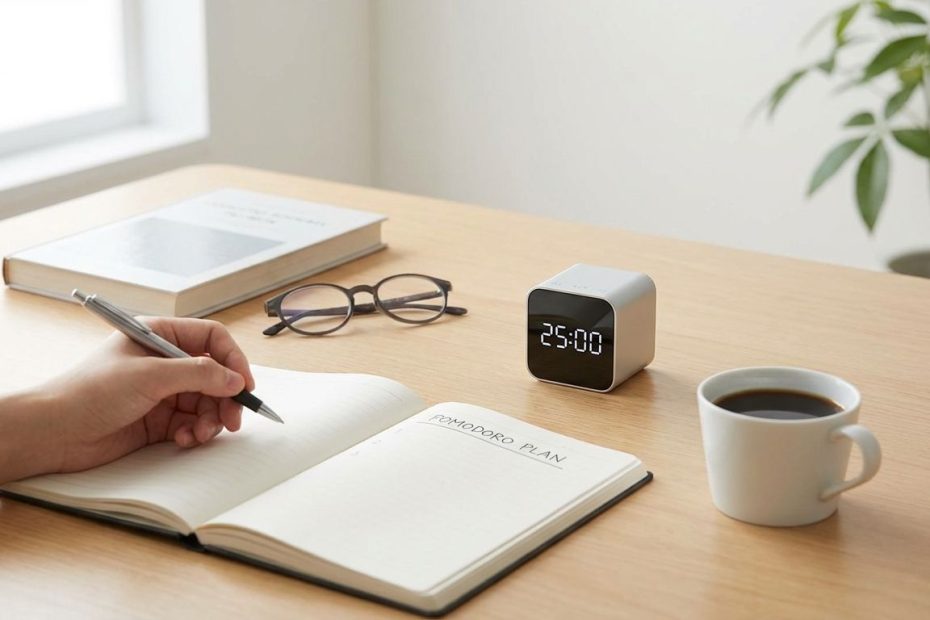
The classic Pomodoro method is simple on paper: work for 25 minutes, break for 3–5 minutes, repeat 4 times, then take a longer break of 20–30 minutes. That pattern is widely taught in academic coaching, and it’s a solid default when you need structure fast. The part most students miss is that a Pomodoro is not “time spent near homework,” it’s a protected interval of single-task work aimed at a concrete outcome.
To run it like it was intended, start by choosing a target you can finish or visibly advance in one block. “Read Chapter 6” is too big, “outline the key headings and write 8 retrieval questions” is concrete. Set the timer, work the single task, and when distractions show up, don’t negotiate with them, write them down on a scratch list and return to the task immediately.
That distraction list is where Pomodoro becomes a control system instead of a motivational quote. It catches the impulse to open a new tab, check a message, reorganize notes, or start a different assignment. At the end of the 25 minutes, you review the list, decide what matters, and schedule it, rather than letting it hijack the work interval.
Track completion with a visible mark per work block. That mark isn’t for aesthetic journaling, it’s a data point you use to estimate work. Over a week, you’ll start knowing what “one Pomodoro” buys you for calculus problems, lab write-ups, reading-heavy classes, and writing assignments, and planning gets easier because you stop guessing.
Is 25/5 The Best Pomodoro Schedule For Students, Or Should You Do 50/10 (Or Longer)?
25/5 is a default, not a law. Your best schedule is the one that makes you start on time and return from breaks without bargaining, and that depends on the course and the task. If 25 minutes ends right when you reach the hard part, you’ll resent the timer and “accidentally” ignore it, which removes the whole point of the method.
Use a ramp-up rule: if your subject requires setup time, pick a longer interval. Problem sets and technical work often need context, working memory, and momentum, so many students perform better with 45/10 or 50/10. Shorter blocks still work for tasks that drift easily, like reading to extract main ideas, organizing notes, making flashcards, cleaning up citations, or handling admin tasks.
Run interval testing like you would run a training plan: lock one interval for three days on the same type of task, then compare performance. Measure focused minutes completed, break overruns, and how often you restart after interruptions. If you’re doing 25/5 and restarting constantly, you’re not failing at discipline, you’re running an interval that doesn’t match your workload.
A practical upgrade is a “hybrid cycle.” Start with one 25-minute block to get moving, then switch to 50-minute blocks once your brain is engaged. This keeps the anti-procrastination benefit of short starts, and it respects the reality that deep work doesn’t always arrive at minute one.
Pomodoro Doesn’t Work For You, Are You Doing It Wrong, Or Is It Overrated?
Pomodoro fails for predictable reasons, and none of them mean you’re broken. It fails when the timer creates pressure, when it interrupts genuine deep focus, when you treat every assignment like it deserves equal time, or when breaks turn into phone sessions that wreck re-entry. Students often label the whole method “overrated” when they’re actually using a stripped-down timer habit without the parts that make it resilient.
If you lock in and the timer yanks you out, replace “hard stop” with a checkpoint rule. When the timer ends, finish the line you’re on, complete the current problem, or write a two-sentence note that captures what you were doing and what comes next, then break. That note is a re-entry hook, and it keeps you from wasting five minutes after the break trying to remember where you left off.
If the timer creates anxiety, switch the metric from minutes to output. Use the timer only to start, then keep working until you reach a quality checkpoint: “solve 5 problems,” “write 250 usable words,” “answer 15 flashcards with 90% accuracy,” “draft the methods paragraph,” “complete one past-exam section.” You still keep planned breaks, you just stop treating the clock like a judge.
If Pomodoro pushes you into shallow task switching, your task design needs tightening. A single Pomodoro should have one task and one definition of done. “Study chemistry” isn’t a task, it’s a category. “Do pages 3–4 of the problem set, then grade and correct errors” is a task. This change alone fixes a huge share of “Pomodoro doesn’t work” complaints because it removes constant micro-decisions.
What Should You Do During Pomodoro Breaks So You Don’t Lose Momentum (Or Doomscroll)?
Your break determines the quality of your next work block. The goal is to restore attention, not to replace the assignment with a feed that rewires your brain toward novelty. Keep breaks physical, simple, and low-friction, so re-entry feels easy instead of painful.
Use a short break menu you can repeat without thinking. Stand up and loosen shoulders, drink water, rest your eyes by looking far away, do a quick walk to a different room, or do a short breathing reset. If you need a snack, keep it small and predictable, because a “quick snack” that turns into a full kitchen mission kills momentum and often becomes avoidance.
Set a break boundary that blocks spiral behavior. A clean rule is “no feeds during short breaks.” Messages can wait, videos can wait, group chats can wait. If you keep breaking this rule, don’t negotiate harder, change the environment: leave the phone across the room, keep it in a bag, or keep it in another room during work blocks and short breaks.
Long breaks after four cycles can include more freedom, yet they still work best when they reset your body. A short walk, a shower, a proper meal, or a quick errand can restore energy without hijacking the day. Long breaks also work well as planning moments, a quick review of deadlines, updating a task list, and deciding what the next cycle will produce.
My Phone Timer Makes You Procrastinate, What’s The Best Pomodoro Setup For Students?
If your phone is your biggest distraction, don’t build your focus system on your phone. A timer that lives beside social apps is an attention trap, and it trains a pattern of “touch phone, check timer, open something else.” Move the timer off the device and you remove the trigger that starts the spiral.
Use a physical kitchen timer, a small desk timer, a watch timer, or a desktop timer on your laptop. The best setup is the one that starts with one motion and doesn’t require picking up your phone. A simple physical timer also adds a mild sense of seriousness that many students underestimate, it feels like work, not like another app.
Pair the timer with a visible work surface rule. Clear one workspace, put only the active materials on the desk, and keep “later items” off the surface. Visual clutter creates micro-distraction, and those tiny context shifts add up to fewer completed blocks across a week.
If you need accountability, add a structured study session format. Virtual co-working, study rooms, campus libraries, or scheduled sessions with a classmate raise the cost of quitting mid-block. A body-doubling service can also help because it creates a start time you respect and a social reason to stay in the chair.
What Should You Do “Beyond Pomodoro” To Remember More And Study Smarter (Not Just Longer)?
Pomodoro manages attention. Grades improve fastest when attention blocks are filled with learning behaviors that create recall under pressure. The two highest-impact upgrades for most students are retrieval practice and spacing, and they work best when they are scheduled, not improvised.
Retrieval practice means pulling information from memory without looking, then checking and correcting. This can be practice questions, flashcards, writing explanations from memory, or doing problems without notes. Research on test-enhanced learning shows that practicing retrieval beats extra studying for long-term retention, especially when the assessment happens after a delay rather than immediately.
Spacing means returning to material across days instead of cramming it once. You can keep Pomodoro as the container and schedule spaced reviews inside the container. A clean pattern is: learn today, retrieve tomorrow, retrieve again two days later, then once a week. Your reviews can be short, yet they are powerful when they require recall, not rereading.
Build a “Pomodoro study stack” that matches how exams work. One strong pattern is: a creation block (make questions from notes), a retrieval block (answer without notes), a correction block (fix gaps and rewrite the hardest prompts), then a mixed practice block (interleave topics). This turns time management into performance management, because you’re training the exact skill exams measure: accurate recall and problem solving under constraints.
If writing is the task, build retrieval into writing too. Draft from an outline without looking at sources, then verify facts and add citations after. This prevents the common trap of “research browsing” that feels productive yet produces very little writing.
Best Pomodoro Schedule For Studying
- Default: 25/5 × 4, then 20–30 min break
- Deep work: 45/10 or 50/10
- Rule: pick the interval that keeps you starting and returning
Turn Pomodoro Into A System You Can Rely On During Exam Weeks
Pomodoro works when you treat it as a system for protecting focus, not a rigid timer ritual. Lock down single-task blocks, write distractions down, and choose intervals that match the work instead of forcing every subject into 25 minutes. Protect breaks from phone spirals with environment changes, then add retrieval practice and spacing so your study time produces recall that survives test day. Measure what you complete, adjust your intervals based on restart rate and output, and keep a checkpoint rule so deep focus doesn’t get cut off at the worst moment. With those upgrades, time management stops being motivational and becomes operational, you’ll know what to do when you sit down, how long you’ll do it, and what result you’ll produce.
References
- Oregon State University Academic Success Center: Pomodoro Technique
- Pomodoro Technique (Official): Francesco Cirillo
- Focusmate: Virtual Co-Working (Body Doubling)
- Roediger & Karpicke (2006): Test-Enhanced Learning (PubMed)
- Karpicke & Roediger (2007): Spaced vs Expanding Retrieval (PubMed)
- Reddit: “Is the Pomodoro technique overrated or are we just using it wrong?”
- Reddit: “Does the pomodoro technique work for you?”
- Reddit: “Have any of you guys used the Pomodoro Technique?”
- Reddit: “Pomodoro doesn’t work for me unfortunately”
- Reddit: “What To Do In Pomodoro Breaks?”
- Reddit: “Do you use pomodoro technique when studying?”