
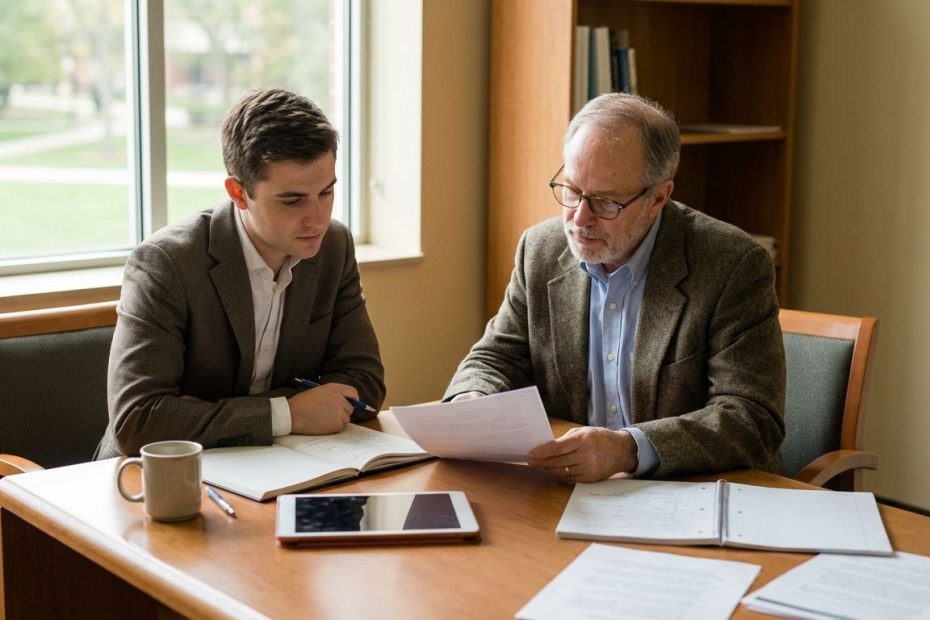
A strong academic mentor accelerates your research, sharpens your professional judgment, and expands your opportunities, provided you choose deliberately and set expectations early. You earn the biggest payoff when you treat mentorship as an operating system: clear goals, consistent communication, and documented agreements that protect time, feedback quality, and career progress.
This guide shows how to identify the right mentor (even without connections), run a focused “mentor interview,” spot red flags before you commit, and maintain a relationship that stays useful for years. You’ll leave with practical scripts, meeting structures, and expectation-setting tools you can implement immediately, whether you’re an undergrad researcher, grad student, or postdoc.
How Do You Find An Academic Mentor If You Don’t Already Have Connections?
You find an academic mentor faster when you stop searching for “a perfect person” and start building access points. Your best entry routes are the places faculty already expect early-career scholars to show up: office hours, seminars, departmental talks, journal clubs, poster sessions, and lab open houses. When you’re consistent in those spaces, you become familiar, and familiarity lowers the friction for a real conversation.
Start by writing a one-page target list that ties mentors to your concrete goals: research topic alignment, method alignment, and career outcomes you want to copy. Yale’s postdoc guidance stresses doing your own reflection first, then reviewing faculty work and recent publications to build a short list that fits your interests and professional direction. That sequence matters because it keeps your outreach specific and makes your “why you” and “why them” message credible.
When access is limited, use adjacent connectors that are easier to reach than the mentor you want. Postdoc offices, graduate program staff, seminar organizers, and research center administrators often know who actually mentors well versus who simply has status. Ask for two names from each connector, then cross-check those names by looking at lab websites, recent papers, and trainee outcomes.
Do not skip the trainee backchannel. Community advice across graduate and postdoc forums repeats the same operational rule: talk to current lab members and alumni before you commit. When an advisor resists connecting you to current trainees or alumni, treat it as a signal that due diligence is being blocked, not as an inconvenience you should politely tolerate.
Keep the initial ask small and time-bounded. A mentorship relationship often starts as a single, well-run conversation that produces one actionable next step. Once you deliver on that next step, you earn a second conversation, and the relationship becomes real through momentum rather than promises.
What Should You Say In The First Email To A Professor You Want As A Mentor?
Your first email should earn a “yes” to a short meeting, not force a long decision. Faculty respond when they see fit, clarity, and respect for time. Keep the message tight, professional, and anchored to one concrete purpose: feedback on a direction, guidance on training decisions, or alignment on a potential project.
Use a structure that signals maturity: who you are, why you’re reaching out to them specifically, what you’re deciding or building, and a simple request for 20 minutes. Yale’s mentor-interview guidance recommends preparing questions that reveal expectations, evaluation norms, meeting frequency, and the mentor’s track record with trainees. Referencing those themes in your email shows you know what you need to assess, and that you will not waste the meeting on vague career talk.
Keep attachments minimal and high-signal. One short artifact can help: a 1-page research interest statement, a draft abstract, or a half-page summary of your current project question. The goal is to give the mentor enough material to react intelligently without giving them homework that triggers delay.
Make scheduling easy. Offer two or three time windows, include your time zone, and propose video or in-person options. If you’re at the same institution, suggest a location that is convenient for them.
Use language that treats mentorship as professional collaboration. You are not asking for rescue, permission, or a favor. You are proposing an exchange: your preparation and execution in return for their judgment and guidance.
How Do You Know If A Potential Mentor Or Advisor Is A Red Flag Before You Commit?
You can reduce mentor risk with a simple triage model: outcomes, availability, and culture. Outcomes cover where trainees land and how long it takes them to finish. Availability covers meetings, response times, and feedback quality. Culture covers how credit, authorship, and conflict get handled day to day. You do not guess these, you verify them by interviewing multiple trainees and looking for repeat patterns.
Use written standards to define what “acceptable” looks like, then compare the mentor against them. The NIH intramural mentor guidelines state minimal requirements that include being readily available, responding within 24 hours to specific trainee inquiries, and meeting in person at least every two weeks. If a potential mentor treats those baselines as unrealistic, you are not looking at a “different style,” you are looking at a training environment that may not support steady progress.
Insist on trainee references and use them properly. Ask to speak with at least two current trainees and at least one recent alumnus. Alumni are often the most candid about what happens when funding is tight, deadlines are missed, or a paper stalls. If a mentor offers only one carefully selected trainee, keep probing politely until you get a broader view.
Audit the mentor’s promises against observable behavior. If someone advertises strong career support, ask what that looks like operationally: who reviews your drafts, how introductions happen, how conference opportunities are allocated, and how they handle authorship. Yale’s suggested interview prompts include asking how performance is evaluated, how feedback is delivered, and what opportunities exist for professional development. Those questions work because they force specifics.
Watch for power and boundary signals. If a mentor discourages you from building a committee network, dismisses institutional resources, or frames mentorship as loyalty, treat that as risk. Duke Biology’s mentorship expectations explicitly emphasize a written mentorship compact that covers communication, meeting frequency, and timeliness of feedback, and it encourages structured check-ins tied to milestones. A mentor who refuses any version of documented expectations is making it harder for you to protect your time and training quality.
Do not rely on charisma or reputation. A famous name does not compensate for poor feedback cadence, inconsistent expectations, or unpredictable credit assignment. You need a mentor who runs a stable operating rhythm.
How Often Should You Meet With An Academic Mentor, And What Should You Talk About?
Meeting frequency should match the work, not tradition. If you are executing a research plan with active experiments, weekly or biweekly meetings keep decisions from stalling. If you are in a writing-heavy phase, shorter check-ins with clear draft deadlines often outperform long, infrequent meetings. The NIH guidelines’ “at least every two weeks” baseline is a useful default when research is moving and you need steady corrections.
Make every meeting decision-driven. Bring a one-page agenda that answers three questions: what changed since last time, what decisions are needed now, and what you will deliver next. If you walk in with raw updates and no decision requests, you train your mentor to treat the meeting as optional. If you walk in with two crisp decisions and supporting data, you train your mentor to show up prepared.
Use a consistent meeting format to increase trust and reduce friction. Keep a running document with: current goals, key results, open questions, and the last set of action items. After the meeting, send a short recap email with deliverables, owners, and dates. This creates accountability without conflict, and it gives you a record that protects you if expectations drift.
Balance research and career topics on a schedule. Career development fails when it is only discussed during emergencies. NIH’s guidance includes annual written and oral assessments and a discussion of professional goals. Apply that logic by setting quarterly career check-ins where you review skills gaps, publication pipeline, conference plans, and job timelines.
When a mentor is busy, protect the cadence with a fallback plan. Ask who the “surrogate” is when the mentor travels, and how decisions get made when you cannot wait. NIH explicitly notes a surrogate when the mentor is on travel, which is a practical detail that prevents weeks of lost time.
Can You Have Multiple Academic Mentors At The Same Time?
Yes, and you usually should. One person rarely covers research direction, methods depth, writing quality, career sponsorship, and institutional navigation at a high level. A mentorship team reduces single-point failure, gives you stronger feedback, and makes your progress less dependent on one person’s schedule or priorities.
Build a portfolio of mentors with distinct roles. A common structure works well across disciplines: a primary research advisor for project ownership and publication strategy, a methods mentor for technical competence, a career sponsor for visibility and introductions, and a peer mentor for operational know-how. When you define roles, overlap becomes collaboration rather than politics.
Use transparency to avoid confusion. Keep your primary advisor informed about who is advising what and why. This is not permission-seeking, it is coordination. It prevents duplicate guidance and reduces the risk of accidental mixed messages about direction or credit.
Formal documents help you manage multi-mentor systems. The AAMC “Compact Between Biomedical Graduate Students and Their Research Advisors” exists to initiate discussions about mutual responsibilities and to support a positive mentor-mentee relationship. Even outside biomedical programs, compact language gives you a neutral way to discuss expectations without making it personal.
Commit to building your committee, not just your advisor relationship. Duke’s mentorship expectations emphasize committees and structured milestones, plus a culture where students have access to a network of mentors. That model protects you as your project evolves and gives you more stable guidance across years.
How Do You Maintain A Mentorship Relationship Long-Term Without Feeling Like You’re Bothering Them?
You maintain mentorship by making it easy to continue. Mentors disengage when interactions are unstructured, when updates are vague, or when your asks feel like open-ended labor. You keep the relationship strong by sending concise updates, showing follow-through, and bringing decisions they can influence.
Run a predictable update rhythm. Every four to eight weeks, send a short message that includes: what you shipped, what you’re doing next, and one specific question. Keep the question decision-shaped, not brainstorming-shaped. A mentor can respond quickly to “Which of these two journals fits this paper?” and may postpone “What should my career be?”
Protect the relationship with expectation-setting early. Duke Biology’s mentorship compact concept is practical: write down meeting cadence, response time expectations, and feedback timelines, then revisit them at milestones. When expectations live in writing, you spend less time negotiating and more time producing.
Show professionalism in small operational choices. Give lead time for recommendation letters, share deadlines early, and provide a bullet list of what you want the letter to emphasize. Mentors are more willing to sponsor you when you make sponsorship easy.
Use gratitude as a professional signal, not a performance. A short thank-you that mentions the specific action you took based on their advice reinforces that their time produces results. That reinforcement is what keeps mentors engaged over years.
What Do You Do If The Mentorship Isn’t Working, Or You Need To End It Professionally?
When mentorship fails, act early and make the fix operational. Start by diagnosing the failure mode: unclear expectations, mismatched communication cadence, low-quality feedback, lack of access, or misalignment on goals. Then propose a new working plan with specific changes: meeting schedule, agenda format, draft turnaround targets, and decision ownership.
If the relationship still does not produce progress, narrow the scope. A mentor does not need to be your main advisor to remain useful. You can shift them into a lighter role: occasional career check-ins, methods consultation, or introductions. This preserves goodwill and keeps doors open without keeping you stuck.
End the relationship with clarity and professionalism. State what you appreciated, state what you are changing, and state what contact will look like going forward. Keep it short and avoid debate. Your goal is a clean exit that protects your reputation and your time.
Use institutional support when the issue involves neglect, hostile behavior, or unethical practices. Document meeting dates, feedback timelines, and commitments. Written expectation tools, including compacts and mentorship documents, give you neutral language to describe misalignment. When escalation is necessary, you need records, not emotion.
Protect your continuity by lining up alternatives before you exit. Secure a committee member, secondary mentor, or program-level advisor who can stabilize your progress during the transition. The strongest transitions are quiet, planned, and documented.
How Do You Find And Keep An Academic Mentor?
Pick 3 targets, email for a 20-minute chat, verify with trainees, agree on meeting cadence and feedback timelines in writing, send concise updates, follow through.
Turn Mentorship Into Measurable Progress
You get the power of mentorship when you treat it as a professional system: choose mentors through evidence, run a structured interview, and lock expectations early so feedback and decisions stay consistent. Keep meetings decision-driven, document action items, and protect your publication and career timeline with predictable cadence. Build a mentorship team so no single person becomes a bottleneck, and maintain momentum with concise updates that make it easy for mentors to respond. When mentorship stops working, renegotiate operationally, then reduce scope or exit cleanly with your next support lined up. Implement these habits and you will publish faster, build stronger skills, and make better career moves with less wasted time.
References
- Yale Office for Postdoctoral Affairs: Finding a Mentor & Interview
- NIH Office of Intramural Research: Guidelines for Mentors at NIH
- AAMC: Compact Between Biomedical Graduate Students and Their Research Advisors
- Duke University Biology Department: Mentorship Expectations
- Reddit r/postdoc: Advisor Red Flags (Community Discussion)
- Reddit r/PhD: Choosing Your Advisor (Community Discussion)
- Reddit r/PhD: Supervisor Red Flags (Community Discussion)
- Reddit r/GradSchool: Meeting Frequency With Advisors (Community Discussion)
- Reddit r/mentors: Scaling Back a Professional Mentor Experience (Community Discussion)