
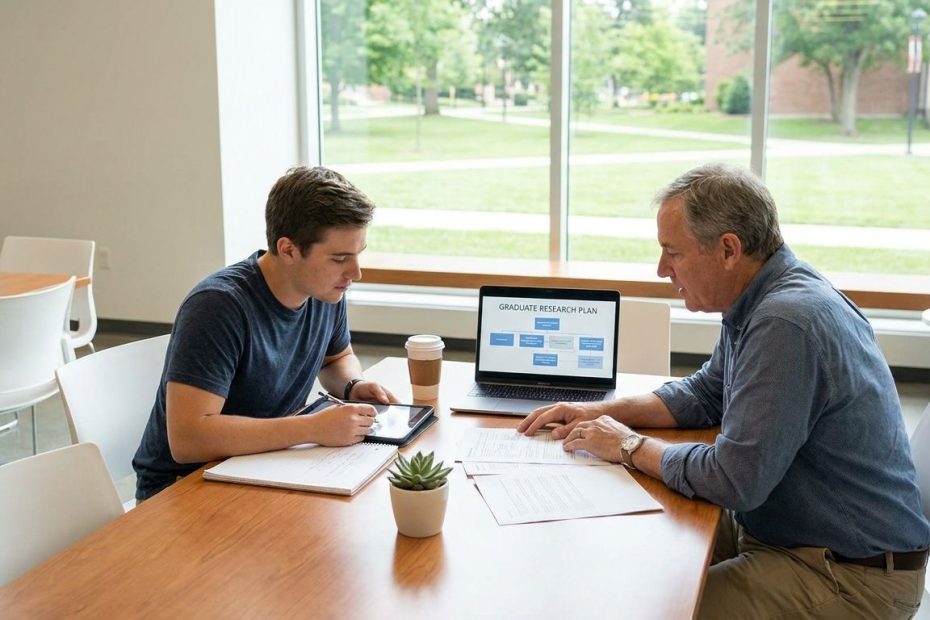
An undergraduate research plan strengthens grad applications by showing that you can ask a focused question, work with evidence, handle setbacks, and explain your contribution clearly. Admissions committees don’t just want proof that you earned strong grades; they want signs that you’re ready for graduate-level inquiry.
If you’re aiming for a master’s program, a Doctor Of Philosophy(PhD) program, or a funded research path, your plan needs more than “join a lab someday.” You need a timeline, a mentor strategy, visible outputs, and a way to translate your work into a strong curriculum vitae(CV), statement, and recommendation letters. The goal is to help you build research credibility without assuming you attend a major research university or already have a publication.
Why Undergraduate Research Is The X-Factor In Grad Admissions
Research experience gives admissions readers evidence that you understand how knowledge gets built in your field. A transcript can show academic preparation, but a research role shows how you respond when a question has no answer key. That matters most for PhD admissions, where programs are evaluating your ability to grow into an independent scholar. It also helps master’s applicants, especially when the program includes a thesis, capstone, fieldwork, or faculty-supervised project.
The strongest research profile is not always the longest one. A student who spends one year developing a focused project, presenting a poster, writing a senior thesis, or helping analyze data can be more convincing than a student who lists several vague assistant roles. Admissions readers care about what you did, what you learned, and whether a faculty mentor can speak to your research potential. Your application becomes stronger when your grades, research, statement, and letters point in the same direction.
Published work can help, but it is not the only way to show readiness. A study of biomedical PhD applicants found that publications and presentations were associated with stronger admission outcomes, which makes sense in fields where research output is a common signal. Still, many undergraduates do meaningful work that never becomes a paper before applications are due. Your plan should aim for contribution, clarity, and mentorship first; publication is a bonus when the timeline and field make it realistic.
The Undergraduate Research Plan From First Year To Senior Year
A good undergraduate research plan starts with exploration and moves toward ownership. In your first year, focus on discovering which questions interest you, which faculty members work in those areas, and which skills appear again and again in your field. Read department websites, attend talks, visit office hours, and take note of methods that keep showing up. You don’t need to sound like a future expert yet; you need to become a student who asks better questions each semester.
During your second year, move from curiosity to participation. That can mean joining a research group, assisting a professor with literature review, helping prepare materials, learning software, coding interview transcripts, working with archival sources, or supporting a campus project. Keep a simple research log with dates, tasks, tools used, readings completed, and questions you asked. This record becomes useful later when you write your CV, personal statement, and mentor update emails.
Your third year is the time to seek project ownership. Ask whether you can take responsibility for a small part of a larger project, design a poster, prepare a short presentation, or develop an independent question under supervision. Your fourth year should turn that work into evidence: an honors thesis, capstone, conference poster, writing sample, research portfolio, code repository, public presentation, or faculty-reviewed paper. You’re building a trail that shows growth, not just activity.
How To Find Research Opportunities When Your College Is Not A Major Research University
If your college has limited research infrastructure, start with people before programs. Look for professors who publish, supervise independent studies, teach advanced seminars, manage community projects, or maintain partnerships with outside organizations. Ask specific questions: whether they need help with source gathering, data organization, interview coding, experiment preparation, translation, mapping, text analysis, or literature review. A precise offer is easier to say yes to than a general request for “research experience.”
Summer programs can expand your options. Research Experiences For Undergraduates(REU) programs, summer undergraduate research fellowships, university research institutes, museums, archives, policy centers, hospitals, and nonprofit research offices can all provide structured experience. If paid opportunities matter because you work during the academic year, prioritize programs that include stipends, housing, or travel support. If you don’t receive a summer placement, you can still build momentum through an independent study, remote collaboration, or a project based on publicly available datasets, archives, or texts.
Students at smaller colleges can also use proximity. Nearby universities, state agencies, libraries, labs, and community organizations may have projects that need careful undergraduate help. Your outreach should be short and tailored: name the project, explain the skill or course background you bring, mention your availability, and ask whether a meeting would be possible. You’re not asking for a favor in vague terms; you’re offering time, attention, and follow-through.
How To Move From Passive Assistant To Project Owner
Admissions committees read between the lines of research descriptions. “Assisted with lab tasks” says less than “analyzed survey responses, identified recurring themes, and presented findings at a campus symposium.” Your job is to move from task completion toward intellectual contribution. That shift often starts with small habits: reading the articles your mentor recommends, asking why a method was chosen, and connecting your weekly tasks to the larger research question.
Project ownership does not require you to invent a separate study from scratch. You can own a dataset cleanup process, a literature review section, a set of interviews, a primary-source collection, a coding script, a field observation protocol, or a comparison across cases. The best move is to ask your mentor what part of the project could become a self-contained poster, thesis chapter, or writing sample. A contained project gives you something real to explain in applications.
Failed results do not ruin your application. Graduate-level work includes uncertainty, revision, and dead ends. If your experiment did not work, your archive had gaps, your model performed poorly, or your interviews raised new problems, describe what you changed and what you learned from the process. Admissions readers can respect a student who understands method, limits, and next steps.
Conferences, Posters, And Papers: What Actually Moves The Needle?
Publications are valuable, especially in fields where coauthored undergraduate papers are possible. A first-author paper can be a strong signal because it shows sustained responsibility for a project. A coauthored paper can also help when your role is clear. Still, undergraduate publishing depends on field, mentor, timing, project type, and access to research infrastructure.
Posters and presentations are often more realistic and still useful. A campus research symposium, regional conference, discipline-specific undergraduate event, or summer program presentation gives you a deadline and a finished product. It also teaches you how to explain your work to people who may not share your exact topic. That skill matters when writing a graduate statement or speaking in an interview.
Different fields produce different outputs. Science, Technology, Engineering, And Mathematics(STEM) students may show posters, lab contributions, code, datasets, protocols, or coauthored manuscripts. Humanities students may show a senior thesis, archival project, translation analysis, annotated bibliography, digital exhibit, or writing sample. Social science students may show field notes, survey design, interview analysis, statistical work, policy research, or mixed-methods projects. The output should match the standards of your discipline.
Turning Research Into A Compelling Personal Statement And CV
Your personal statement should make your research path easy to follow. Start with the question that pulled you in, explain what you did, name the methods or materials you used, and connect the experience to the graduate work you want to pursue. Don’t exaggerate your role. A precise description of a modest contribution is stronger than inflated language about changing the field.
Use your CV to show evidence in clean categories. Include research roles, mentors, institution names, project titles, methods, presentations, papers, awards, relevant coursework, technical skills, languages, archives, software, fieldwork, or creative research materials. Under each role, write bullets that begin with action: analyzed, coded, reviewed, collected, compared, presented, drafted, revised, organized, or designed. Keep the focus on what you did and what the project required.
Your statement and CV should support each other without repeating the same wording. The CV gives the record; the statement explains the meaning. If your research started late, use the statement to show rapid growth and a clear future direction. If you have no publication, use the statement to show process, judgment, and readiness for mentored graduate work.
How To Secure A Strong Recommendation Letter From A Research Mentor
A strong research letter grows from consistent communication. Your mentor needs to see how you think, not just that you complete assigned tasks. Ask questions during meetings, send brief progress updates, meet deadlines, and keep track of your contributions. These habits give your mentor specific material to describe when they write.
Ask early and make the letter easy to support. Send your CV, draft statement, transcript if requested, project summary, list of programs, deadlines, and a short note explaining what you hope the letter can emphasize. If the mentor supervised your research closely, ask whether they can write a strong letter about your research potential. That wording gives them room to answer honestly.
If a mentor says they’re too busy or seems hesitant, don’t panic. A lukewarm letter can weaken an application, so it is better to know early. You can ask another faculty member who knows your work well, combine a course instructor letter with a research mentor letter, or request a shorter letter for programs where research is less central. Your goal is not a famous recommender; it is a detailed recommender.
Adapting The Plan For STEM, Social Sciences, Humanities, And Arts
In STEM fields, research often centers on labs, computational work, engineering design, field stations, clinical research support, or applied technical projects. Your plan should prioritize method training, safety or ethics training where required, data handling, and repeated mentor feedback. A strong STEM application usually explains your role in a project, the method you used, and what the findings or obstacles taught you. If you can present a poster or contribute to a manuscript, that helps make the work visible.
In social sciences, research may involve interviews, surveys, statistical analysis, case comparison, field observation, policy review, or community-based work. Your plan should show that you can connect theory with evidence and follow responsible research practices. A good output could be a thesis, poster, policy memo, conference paper, dataset documentation, or writing sample. Admissions readers want to see that you can define a question and choose a method that fits it.
In humanities and arts fields, research may look less like a lab and more like sustained interpretation. You might work with archives, primary sources, languages, manuscripts, performances, exhibitions, design processes, oral histories, or critical theory. Graduate programs in these fields often value a strong writing sample, senior thesis, portfolio, or long-form project that shows depth and originality. The plan still works: explore, apprentice, take ownership, then produce evidence that fits your field.
How To Handle Low GPA, No Publications, Late Start, Or A Failed Project
A lower grade point average(GPA) does not erase strong research, but it does need careful handling. If your grades dipped because of work obligations, family responsibilities, a demanding course sequence, or time spent on research, don’t overexplain. Use your application to show upward trends, strong advanced coursework, and mentor-backed evidence of research readiness. Graduate programs still care about academic preparation, so your plan should include improving grades in courses tied to your intended field.
No publication is common for undergraduates. Many projects take longer than an application cycle, and many mentors do not publish with undergraduate coauthors quickly. Replace the publication gap with other proof: a thesis, poster, presentation, writing sample, research abstract, portfolio, or detailed mentor letter. What matters is whether you can explain your role with specificity.
Starting in junior year is late, but not too late. Choose one research direction and commit to it rather than chasing every opportunity. Use summer, independent study, senior thesis options, and targeted mentorship to build one coherent story. A focused one-year project can still strengthen grad applications when your statement shows purpose and your mentor can confirm growth.
How Does Undergraduate Research Help With Graduate School Applications?
- Shows research readiness
- Builds mentor-backed letters
- Creates CV evidence
- Supports your statement
- Proves you can handle open-ended work
Build The Application Around Evidence, Not Guesswork
The best undergraduate research plan gives you a record of curiosity, discipline, and contribution that an admissions committee can verify. You don’t need a perfect path, a famous mentor, or a publication to make research work in your favor. You need a clear question, steady engagement, honest reflection, and evidence that matches your field. Start where you are, build one layer at a time, and make every research experience easier for a future reader to understand. A strong grad application is not just a list of achievements; it is a case for your readiness to do the work.
References
- Council Of Graduate Schools admissions survey reference
- Hall, J. D., et al., PLOS ONE study on biomedical PhD applicant variables
- University Of Michigan Research Experiences For Undergraduates program information
- University Of California Berkeley undergraduate research timeline
- American Historical Association guide to preparing for graduate school in history
- Nature article on what PhD admissions committees look for
- Council On Undergraduate Research, Characteristics Of Excellence In Undergraduate Research
- Inside Higher Ed article on graduate admissions values and trends
- The Professor Is In article on graduate school admissions