
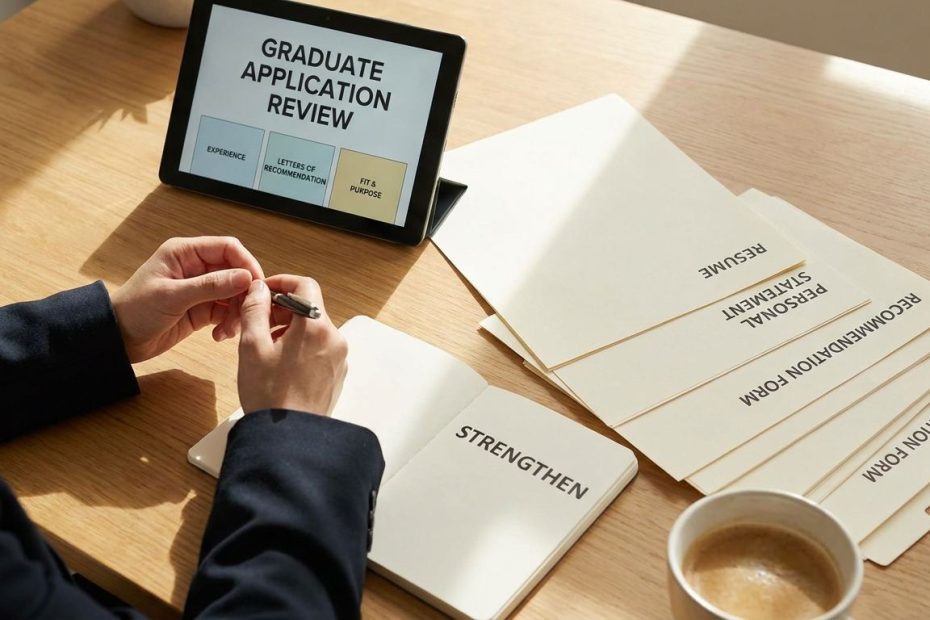
Top graduate programs look beyond Grade Point Average(GPA) to judge whether you can produce strong work in their field, contribute to the program, and succeed after admission. Your transcript matters, but research, work experience, letters, writing, test scores, interviews, and fit often decide the outcome when applicants have similar grades.
If you’re asking what top graduate programs look for beyond GPA, you’re usually trying to answer a more practical question: “How do you prove readiness when grades don’t tell the whole story?” This guide breaks down the application signals that carry weight across Doctor of Philosophy(PhD), Master’s, Master of Business Administration(MBA), public policy, engineering, data science, and similar graduate paths. You’ll see where to focus your time, how to offset weak spots, and how to build an application that feels specific rather than generic.
Why Does GPA Still Matter If It Is Not The Only Factor?
GPA still matters because it gives admissions readers a fast signal of academic consistency, course rigor, and readiness for graduate-level work. Top programs rarely ignore grades, but they read them beside the rest of your file rather than treating them as the whole case.
A strong GPA helps most when it comes from demanding courses related to your target field. If you’re applying to a quantitative program, admissions readers will care about calculus, statistics, programming, economics, engineering, or other relevant technical grades more than unrelated electives. If you’re applying to a writing-based or research-driven program, they’ll look at upper-level seminars, writing samples, research methods courses, and faculty comments when available.
A weaker GPA creates a hurdle, especially at programs with large applicant pools or minimum screening rules. That doesn’t mean your application is finished. It means the other parts of your file need to answer the concern directly: Can you handle the work now, and do you have proof that your past grades don’t reflect your current ability?
Graduate admissions is also discipline-specific. A PhD committee may care more about research promise than polished workplace leadership. An MBA program may care more about career progression, judgment, and leadership than lab experience. A professional master’s program may look for applied skills, internships, portfolio work, or industry readiness.
What Do Top Graduate Programs Look For Beyond GPA?
Top graduate programs look for proof that you can do the work their degree requires. That proof usually comes through research or professional experience, recommendation letters, a focused statement of purpose, test scores when required, interviews, leadership, and a strong match with the program.
The strongest applications don’t treat these pieces as separate boxes. They connect them. Your experience explains your goals, your letters confirm your abilities, your statement shows fit, and your transcript or test scores support academic readiness. When those parts reinforce one another, the admissions reader sees a person with direction rather than a stack of documents.
Top programs also compare applicants against the purpose of the degree. For a PhD, your file needs to show curiosity, patience, research skills, and the ability to finish long projects. For an MBA, your file needs evidence of leadership, decision-making, communication, and professional momentum. For a public policy, public administration, engineering, or data science program, committees often look for a blend of academic strength, applied experience, and clear career purpose.
This is where many strong-GPA applicants fall short. They assume grades speak for themselves. In a competitive pool, grades only open the door; the rest of the application explains why you belong in that specific program now.
How Important Is Research Or Industry Experience?
Research or industry experience can outweigh GPA when it proves you already understand the work of the field. For PhD applicants, research experience is often one of the strongest signals in the application; for professional master’s applicants, relevant work can play the same role.
For a PhD, admissions readers want evidence that you’ve done more than earn high marks in class. They want to know whether you can ask a focused question, work through uncertainty, handle feedback, use methods correctly, and stay with a project long enough to produce results. A summer research role, honors thesis, lab position, archive project, fieldwork assignment, or conference poster can carry weight when it shows real contribution.
Professional programs read experience differently. An MBA committee may look for career progression, responsibility, leadership, and judgment under pressure. A public administration program may value policy, nonprofit, government, military, education, or civic experience. A data science or engineering program may look for projects, internships, technical roles, code repositories, product work, or applied problem-solving.
The name of the employer or lab helps less than the substance of the work. A “brand name” placement with shallow tasks may say less than a smaller role where you owned analysis, managed stakeholders, wrote reports, built models, or contributed to research design. Your application should explain what you did, what changed because of your work, and what skills you’ll bring into graduate study.
Do Letters Of Recommendation Matter More Than GPA?
Letters of recommendation can matter more than GPA when they come from people who have directly supervised your research, academic work, or professional performance. A strong letter gives the committee evidence that your abilities have been tested by someone qualified to judge them.
The best letters are specific. They describe how you think, how you solve problems, how you respond to criticism, and how your work compares with peers. A vague letter from a famous professor can be weaker than a detailed letter from a research supervisor, manager, or instructor who knows your work well.
For research degrees, a letter from someone who supervised your research is especially valuable. It can speak to persistence, independence, technical skill, writing ability, and readiness for graduate-level inquiry. For professional degrees, a supervisor or senior colleague can show leadership, communication, ethics, initiative, and measurable contribution without relying on inflated praise.
You can improve your letters by making the recommender’s job easier. Share your statement of purpose draft, résumé, transcript, target programs, deadlines, and a short list of projects you worked on together. Don’t ask, “Can you write me a letter?” Ask whether they can write a strong letter. That wording gives them room to be honest and helps you avoid a lukewarm recommendation.
What Makes A Statement Of Purpose Stand Out?
A strong statement of purpose shows what you want to study, why that program fits, and what evidence proves you’re ready. It should read like an intellectual and professional pitch, not a personal autobiography.
Your statement should answer four questions without sounding mechanical: What problem or field are you drawn to, what preparation have you built, why does this program fit, and what do you plan to do with the training? Specificity matters. Naming a research area, method, faculty fit, curriculum strength, lab, center, clinic, studio, practicum, or professional pathway shows that you’ve done real program research.
Generic statements often fail because they could be sent to any school. “I am passionate about helping people” or “I have always loved science” doesn’t give a committee enough to evaluate. A sharper version links your coursework, projects, research, or work experience to a defined graduate goal.
If your GPA is weak, your statement can help, but it shouldn’t make excuses. Use one brief explanation if needed, then move quickly to proof of growth: stronger recent grades, advanced coursework, research performance, professional results, technical certifications, or improved test scores. The goal is to show readiness now, not to relitigate every semester from the past.
Can GRE Or GMAT Scores Offset A Lower GPA?
Graduate Record Examination(GRE) or Graduate Management Admission Test(GMAT) scores can help offset a lower GPA when programs accept or require them. They work best when the score directly addresses the academic concern raised by your transcript.
If your GPA is low because of weak quantitative grades, a strong quantitative GRE or GMAT score can show current readiness for statistics, finance, analytics, economics, engineering, or data-heavy coursework. If your writing record is uneven, a strong writing sample or verbal score may help, depending on the program. Scores rarely erase a weak record by themselves, but they can give admissions readers another standardized point of comparison.
Many programs have changed how they use test scores, so you need to read each program’s requirements carefully. Some require scores, some make them optional, and some don’t review them. If a score is optional, submit it only when it strengthens the story your file is already telling.
Test scores are most useful when paired with other evidence. A strong score plus recent A-level coursework, research output, or demanding professional work sends a much better signal than a strong score alone. Your goal is to reduce doubt from several directions.
How Do Interviews And Program Fit Affect Admission?
Interviews and program fit affect admission by showing whether your goals, communication style, and preparation match the program. At selective programs, the interview can confirm the strengths in your file or expose gaps that weren’t obvious on paper.
For PhD applicants, fit usually means alignment with faculty interests, methods, research questions, and advising capacity. You don’t need to sound like you’ve already written the dissertation. You do need to show that your interests are informed enough to belong in that department, with that faculty, using that training.
For MBA and other professional programs, fit may include leadership style, career goals, teamwork, maturity, communication, and clarity about why the degree makes sense now. Admissions readers want to know that you understand the program’s format, strengths, and outcomes. They also want to see that you can contribute in class, projects, labs, cohorts, or practicum settings.
Prepare for interviews by reviewing your application line by line. Anything you submitted can become a question. Be ready to discuss decisions you made, problems you solved, feedback you received, and why the program connects to your next step. Avoid rehearsed answers that sound detached from your real experience.
Do Extracurriculars, Leadership, And Personal Background Help?
Extracurriculars, leadership, and personal background help when they show skills or qualities relevant to graduate success. They matter less as a list of activities and more as evidence of contribution, responsibility, resilience, or service.
Graduate programs don’t usually reward activity volume the way some undergraduate admissions processes do. Ten clubs with thin involvement say less than one or two sustained commitments with real responsibility. Teaching, mentoring, community projects, student leadership, military service, caregiving responsibility, volunteering, entrepreneurship, advocacy, or campus work can matter when you explain what you learned and how it shaped your readiness.
Leadership doesn’t always mean a formal title. You can show leadership by training new employees, coordinating a research team, improving a workflow, managing a client project, leading a student group, organizing data collection, or taking responsibility when a project stalled. The admissions reader is looking for maturity and judgment, not just prestige.
Personal background can also help readers understand your path. If you faced financial pressure, family obligations, a field change, or limited access to research opportunities, the application can explain that carefully. Keep the focus on preparation and growth. The strongest personal material helps the committee understand how you work, what you value, and why graduate study is the right next step.
Can You Get Into A Top Graduate Program With A Low GPA?
You can get into a top graduate program with a low GPA, but you need strong evidence that your current ability is higher than your transcript suggests. The lower the GPA, the more convincing the rest of your application must be.
Start by identifying the reason for the weak record. A single poor year followed by strong upper-level performance is easier to explain than four years of uneven grades. A low overall GPA with strong grades in major courses may be less damaging than weak grades in the exact subjects your graduate program requires.
Then build proof in areas admissions readers respect. Take advanced courses and earn strong grades. Complete a serious research project or professional certification if relevant. Strengthen your writing sample, retake required tests if the program accepts them, and secure letters from people who can speak directly to your current work. If you’ve been out of school for years, recent professional performance can carry weight, especially for applied degrees.
Be realistic about program selection. A low GPA may trigger automatic screening at some schools, so you need a balanced list. Include ambitious programs, good-fit programs, and safer options where your strengths align with the admissions priorities. Reaching high is fine; applying only to programs that screen out your profile is a poor use of time and money.
How Should You Build A Strong Application Beyond GPA?
Build your application around a clear claim: you are ready for this program, in this field, for reasons your file proves. Every major component should support that claim from a different angle.
Begin with program research. Read faculty pages, curriculum details, lab descriptions, placement outcomes, required skills, application instructions, and recent student profiles when available. Then map your evidence to the program’s priorities. A research degree needs research alignment. A professional degree needs career logic. A quantitative degree needs technical proof.
Choose recommenders based on evidence, not status alone. Draft your statement early enough to revise it for each program. Prepare a résumé that highlights outcomes, methods, tools, leadership, and progression. If you submit test scores, make sure they add value rather than distract from stronger parts of your file.
After that, check for gaps. If your file says you want a PhD but shows no research exposure, fix that before applying or explain the closest equivalent experience. If your file says you want an MBA but gives no leadership evidence, rewrite your résumé and essays around responsibility, decisions, and results. If your grades are the weak point, make the rest of the file unusually concrete.
What Do Graduate Schools Look For Besides GPA?
- Relevant research or work
- Strong recommendation letters
- Focused statement of purpose
- Test scores when useful
- Program fit and interviews
- Leadership and personal background
Build The Case Your Transcript Cannot Make Alone
What top graduate programs look for beyond GPA is proof: proof that you can think, research, write, lead, solve problems, and fit the degree you’re pursuing. A high GPA helps, but it won’t rescue a vague statement, weak letters, or a poor match with the program. A lower GPA can be offset, but only when your recent evidence is strong, specific, and relevant. Treat the application as a case you’re building for admission, with every document answering the same question: why are you ready for this program now?
References
- Council of Graduate Schools — Holistic Review in Graduate Admissions
- Nature Careers — How To Get Into A PhD Programme
- Educational Testing Service — The GRE Tests And Holistic Admissions
- University of California, Berkeley Graduate Division — Writing The Statement Of Purpose
- Harvard Kennedy School — Master In Public Administration Admissions
- Wharton MBA — Class Profile
- Carnegie Mellon University Heinz College — What We Look For
- Stanford Graduate School of Business — Evaluation Criteria
- U.S. News Education — What Grad Schools Look For In Prospective Students